Brand identity is no longer just about visuals. In the last century, companies mastered visual design, logos, colors, and typography, to evoke feelings and convey brand values. Today, voice is emerging as the next frontier for branding. Just as specific colors can make customers feel excitement or trust, the qualities of a voice can shape how a brand is perceived. Research shows that sound-driven campaigns (including voice) achieve recall rates as high as 96%, outperforming visual-only ads. In an age of voice assistants, podcasts, and smart devices, a brand’s voice has become its audible logo, a consistent persona that speaks to users across various touchpoints.
We instinctively judge a speaker’s personality and emotion from their voice. Studies in human–computer interaction confirm that people even assign traits like honesty, warmth, or intelligence to synthetic voices, much as we do with human speakers. The human voice triggers immediate emotional responses , making it a powerful tool for branding. A calm, deep voice might convey authority and sophistication, while a lively, upbeat voice sounds friendly and approachable. UX designers and brand managers are beginning to ask: How should our brand sound to reinforce our message and values? This thought leadership piece introduces the concept of VoiceBrandTM, a framework for deliberately shaping voice attributes to transmit brand messages, and outlines the key components of voice that influence customer perceptions.
Voice is becoming as critical to brand identity as visuals. Users naturally anthropomorphize voice interfaces, judging a company’s “personality” by the voice that represents it. A consistent voice persona, across ads, virtual assistants, or customer service lines, builds recognition and trust.
Humans rely on vocal cues to evaluate others “on a multitude of levels, from honesty and trustworthiness to overall intelligence”. In branding, this means that the voice greeting your customers can significantly impact their trust and comfort with your company. An enthusiastic, conversational tone can make a brand feel friendly and accessible, whereas a flat or robotic voice might create distance. Nielsen Norman Group’s user research has shown that even in written content, tone of voice alters perceptions of a brand’s friendliness, trustworthiness, and desirability, and these effects are amplified when a real voice is speaking. The voice becomes the “human touch” that customers interact with, especially in voice-user interfaces or audio advertising.
Moreover, voice branding enables an emotional connection that visuals alone often cannot achieve. A voice can convey subtleties, a smile, empathy, excitement, sincerity, through tone and inflection. As one voice branding expert notes, “The human voice is a powerful tool for conveying emotion… the right voice can make the audience feel the brand’s story in a visceral way”. In audio brand anthems and commercials, the narrator’s voice often embodies the brand’s personality. Is your brand caring and reassuring? Perhaps a warm, gentle voice will convey that. Is it bold and adventurous? Then maybe a confident voice with dynamic energy fits. The tonality, rhythm, and style of a voice-over can communicate brand attributes (authoritative, friendly, fun, etc.) in a way that text or visuals alone cannot. In short, voice creates a persona for your brand, one that listeners subconsciously evaluate within seconds of hearing.
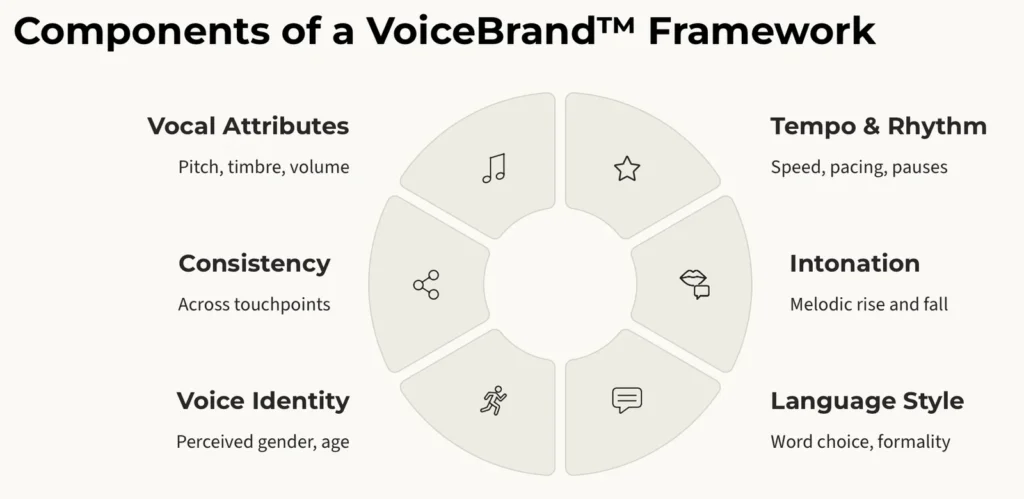
To start shaping a VoiceBrandTM, we need to break down the components of voice that influence listener perceptions. Just as visual branding has elements like color, shape, and font, voice branding has its own key elements. Below is a framework of components to consider when designing a brand’s